
Diamond guide
The 4C of diamonds: cut, colour, clarity and carat
What decides how a diamond looks and what it costs, explained one C at a time, along with the two diamond qualities we offer.
The short answer
The 4C are cut, colour, clarity and carat, the four grades that decide how a diamond looks and what it costs. Cut decides how much the stone sparkles, colour runs from colourless D to yellow Z, clarity describes the small inclusions inside the stone, and carat is weight: 1 carat is 0.2 grams. Our natural diamonds are bought directly in Antwerp, come GIA-certified and are offered in two qualities: Signature (H, SI1–SI2) and Premium (F–G, VS1–VS2).
The 4C at a glance

Cut
Decides how much light the diamond returns. A well-cut stone sparkles more and looks larger.

Colour
Graded from D, completely colourless, to Z, clearly yellow. The less colour, the rarer the stone.

Clarity
Describes the small inclusions found in almost every diamond, from flawless FL to included I.

Carat
The diamond's weight. 1 carat is 0.2 grams and gives a round diamond about 6.5 mm across.
Diamond cut and shape
Cut is about light, shape is about style
Cut and shape are two different things. The shape is the outline you see from above, such as round, oval or princess. The cut grade describes how well the facets are angled and proportioned, and of the four C it matters most for sparkle. A well-cut diamond sends light back up through the top of the stone. A stone cut too deep or too shallow lets light escape through the sides and looks darker, even with good colour and clarity.
The round brilliant cut has 57 facets and gives the most sparkle of all shapes. That is why it is the most common choice for engagement rings.

Round brilliant
The most sparkle of all shapes. Classic in a solitaire ring.

Princess
Square with pointed corners and a modern look.

Oval
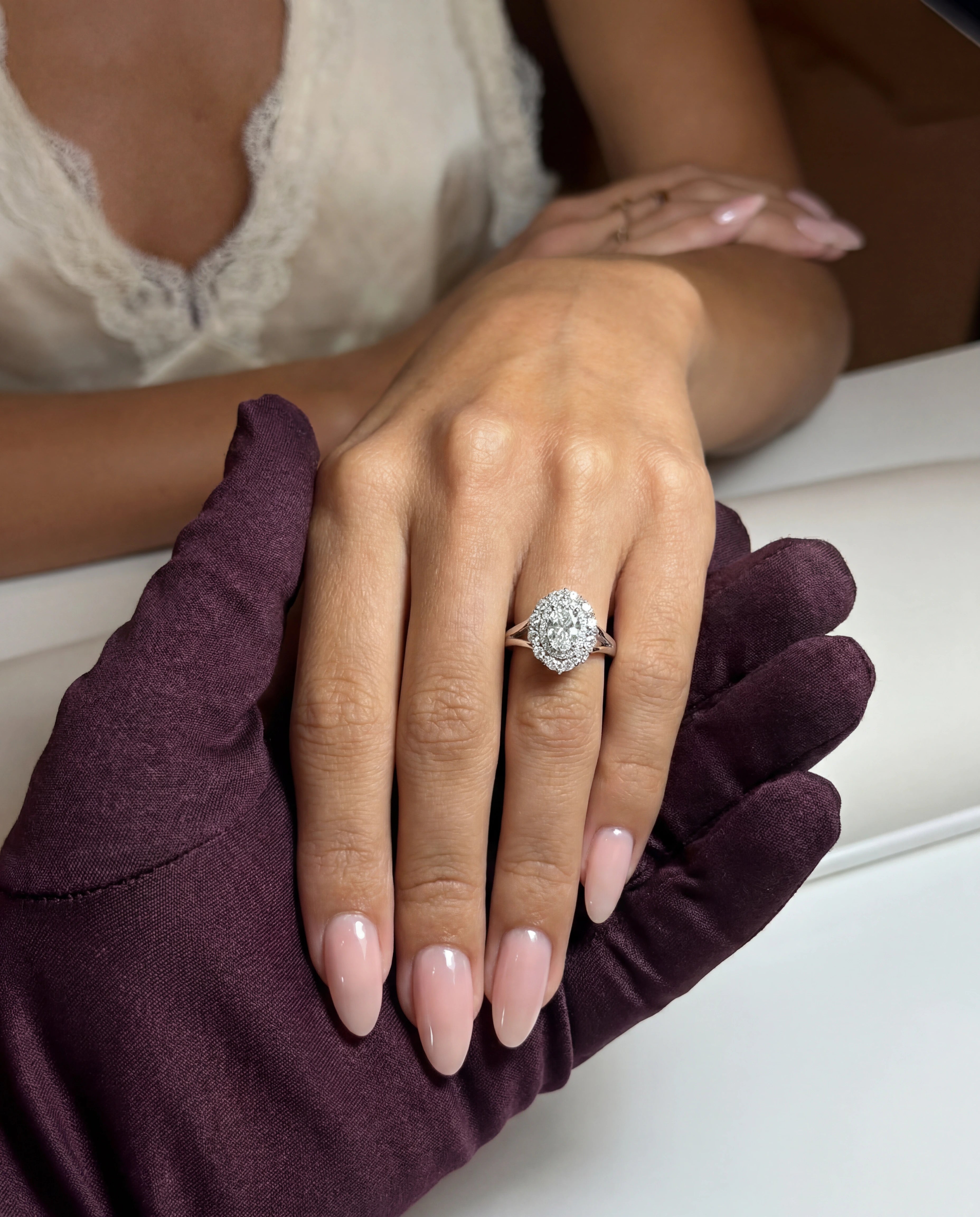
Elongated, looks larger than a round stone of the same weight and lengthens the finger.

Emerald
Rectangular with step-cut facets that give long flashes of light rather than sparkle.
Diamond colour
Diamond colour is graded on a scale from D to Z. D is completely colourless, and each step down the alphabet adds a faint warm tint. In Sweden the older trade names are still used, so you will also see River, Top Wesselton and Wesselton. The difference between two neighbouring grades is hard to see with the eye, especially once the stone is set.
 RiverRiverTop WesseltonPremium
 Top WesseltonPremiumWesseltonSignature
 Top CrystalCrystal


 RiverRiverTop WesseltonPremium
Colourless
Top WesseltonPremiumWesseltonSignatureNear colourless
Top CrystalCrystalNear colourless, faint tint
Faint yellow
Very light yellow
Light yellow
Fancy colour
Good to know: in white gold and platinum a colourless stone shows best. In yellow or red gold, an H diamond looks just as white, since the metal warms the stone anyway.
Diamond clarity
No two diamonds are alike
Almost every diamond has small inclusions, tiny crystals or feathers that formed as the stone grew. Clarity is graded under 10x magnification, from flawless FL down to included I1–I3. The fewer and smaller the inclusions, the higher the grade.
In VS, and usually in SI, the inclusions cannot be seen with the naked eye. The stone is then called eye clean: you need a loupe to find them. We use no diamonds below SI2.
FL & IF
Flawless
No inclusions, even under magnification. Very rare.
VVS1 & VVS2
Very, very slightly included
Inclusions so small that a trained grader struggles to find them under a loupe.
VS1 & VS2
Very slightly included
Small inclusions that are hard to see under a loupe and invisible to the eye.
PremiumSI1 & SI2
Slightly included
Inclusions you can see under a loupe, normally not with the naked eye.
SignatureIllustration at 10x magnification
Diamond carat
What carat means, and how large a diamond looks on the hand.
What carat means
Carat is a diamond's weight, not its size. One carat is 0.2 grams, and the price rises faster than the weight, because large stones are rarer.

Same weight, different size
Two diamonds of the same carat can look different in size. A stone cut too deep hides its weight underneath, while a well-proportioned stone shows more of it from above.


Choosing your carat
Choose a size that suits the hand and the ring. A stone just under a round number, such as 0.90 instead of 1.00 carat, looks almost the same and often costs noticeably less.

How large is a round diamond?
Approximate diameter of a well-cut round brilliant.
Our two diamond qualities
Our natural diamonds are bought directly in Antwerp and come GIA-certified, with the certificate included. On our engagement rings you choose between two qualities.
Signature
- Colour
- H
- Clarity
- SI1–SI2
Eye clean diamonds with excellent value. No inclusions visible to the naked eye, and a white stone at a more accessible price.
Premium
- Colour
- F–G
- Clarity
- VS1–VS2
Whiter colour and higher clarity. The inclusions are hard to find even under magnification.
Frequently asked questions
Cut, colour, clarity and carat. Together they decide how a diamond looks and what it costs. Cut affects the sparkle most, colour and clarity how pure the stone is, and carat its weight and size.
A diamond that looks white and has no inclusions visible to the eye. For most people that means H or better in colour and SI or better in clarity. Our Signature quality is H and SI1–SI2, and Premium is F–G and VS1–VS2.
A well-cut round brilliant of 1 carat is about 6.5 mm across and weighs 0.2 grams. An oval or emerald cut of the same weight is longer and can look larger from above.
They are clarity grades. VVS means very, very slightly included, VS very slightly included and SI slightly included. The number after, 1 or 2, shows where in the grade the stone sits, and 1 is the better.
They are the older Scandinavian names for diamond colour, still common at Swedish jewellers. River is D–E, Top Wesselton F–G and Wesselton H. Our Premium quality is Top Wesselton and Signature is Wesselton.
Yes. Our natural diamonds are bought directly in Antwerp and come GIA-certified. The certificate comes with the ring.
The round brilliant. Its 57 facets are shaped to send back as much light as possible, which is why it is the most common choice for engagement rings.